Cookie Cost Calculator
See what your cookies really cost to make and what to charge: enter your ingredients as line items plus your labor, overhead, and packaging, and get the cost per cookie broken down by part, a suggested price per cookie and per dozen, and your profit margin.
Every figure here is a value you set. The starting ingredient rows and prices are an illustrative chocolate-chip batch, not your real costs, and the suggested price is simply your cost plus the markup you chose, not market research. Replace the rows with your own prices and compare the result against cookies sold near you before setting a price.
What your cookies cost
Cost to make one cookie $1.49
- Suggested price per cookie
- $2.23
- Suggested price per dozen
- $26.75
- Profit per cookie at that price
- $0.74
- Profit margin at that price
- 33%
It costs $1.49 to make one cookie; with a 50% markup the suggested price is $2.23, leaving $0.74 of profit per cookie, about 33.3% of the selling price.
Cost per cookie, by part
- Ingredients, per cookie
- $0.28
- Labor, per cookie
- $0.83
- Overhead, per cookie
- $0.13
- Packaging, per cookie
- $0.25
Per batch
- Ingredient cost per batch
- $6.66
- Total cost to make one batch
- $35.66
How batch size changes your cost per cookie
| Cookies per batch | Cost per cookie |
|---|---|
| 18 | $1.90 |
| 24 | $1.49 |
| 30 | $1.24 |
Use your browser address bar to share this result after you calculate.
How to use this calculator
- Add one row for each ingredient. Enter how much you use and the size of the package you buy in the same unit, plus what that package costs. The tool divides the two, so you never convert grams to cups.
- Enter how many cookies the batch makes, your hands-on baking time in hours, and the hourly rate you want to pay yourself for that time.
- Add your per-batch overhead, such as oven power and equipment wear, then the packaging cost for a single cookie. Packaging stays separate because it scales per cookie while overhead scales per batch.
- Set your markup over cost. Read back the cost per cookie split into ingredients, labor, overhead, and packaging, plus a suggested price per cookie and per dozen and the profit margin that markup implies.
How this cookie cost calculator works
This cookie cost calculator prices a cookie the way a small bakery does, in the open, from costs you control. The method is cost-plus pricing, also called cost-based pricing: you build the price up from what each cookie actually costs to make (Penn State Extension).
It starts with ingredients. You add one row per ingredient and, for each, enter how much you use and the size of the package you buy in the same unit, plus what that package costs. The tool divides the amount used by the package size and multiplies by the package price, so 226 grams of butter from a 454 gram block that costs $4.50 works out to about $2.24. That is the cooperative-extension idea of a unit price, the package price divided by the number of units in the package (Rutgers NJAES Cooperative Extension). Because both amounts share one unit, the tool never converts between grams, cups, or ounces; only their ratio matters. Add up every row and you have the ingredient cost for one batch. You can work in any currency, as long as you use the same one throughout.
Next it builds the total batch cost. It adds your labor, which is the hands-on hours you enter times the hourly rate you pick, your per-batch overhead such as oven power and equipment wear, and your packaging, which it multiplies by the number of cookies because each cookie gets its own bag or label. Packaging stays separate from overhead on purpose: doubling the batch doubles the packaging but not the oven time, so bundling them would scale your cost wrong.
Then it divides the batch total by how many cookies the batch makes to get the cost per cookie, and it shows that cost split into ingredient, labor, overhead, and packaging parts that add back up to the total. Batch size is the biggest lever here: baking more cookies from one batch spreads the fixed labor and overhead over more units, so a larger batch lowers the cost per cookie.
From there it sets a suggested price by adding your markup on top of the cost. Markup is a percentage of your cost, so a 50% markup on a $1.49 cookie suggests $2.23, shown both per cookie and per dozen. The tool also reports the profit margin, which is profit as a share of the selling price. Markup and margin are not the same number: a 50% markup is a 33% margin, and the two are easy to confuse (Corporate Finance Institute, AccountingTools). Showing both keeps them straight. Every figure here is one you set, so treat the suggested price as a transparent starting point to compare against what your local market will actually pay.
Examples
Chocolate-chip batch of 24. Enter the example chocolate-chip batch and the three ingredient rows cost $2.24 for butter, $3.99 for chocolate chips, and $0.43 for flour, an ingredient cost of $6.66. One hour of labor at $20, $3 of overhead, and $0.25 of packaging per cookie across 24 cookies bring the batch to $35.66, or $1.49 per cookie. A 50% markup sets the suggested price at $2.23 per cookie and $26.75 per dozen, leaving $0.74 of profit per cookie, a 33% margin.
The same recipe, doubled to 48. Keep that recipe but bake 48 cookies instead of 24. The ingredient cost is still $6.66, yet the fixed labor and overhead now spread across twice as many cookies, so the cost falls to $0.87 per cookie. At the same 50% markup the suggested price drops to $1.30 per cookie and $15.62 per dozen. This is why batch size is the strongest lever on your per-cookie cost.
A single dough-mix row at 100% markup. For a different recipe, take one row of cookie dough at $4.00 for a 500 gram tub, using 200 grams, in a batch of 12 with a half hour of labor at $16. The ingredient line is $1.60, the batch costs $11.80, and each cookie costs $0.98. A 100% markup doubles that to a $1.97 suggested price and $23.60 per dozen. Notice that the 100% markup is only a 50% margin, a reminder that the two measures are never the same.
What the data says
If you bake to sell, the hardest question is rarely how to make the cookie. It is what to charge for it. Plenty of home bakers undersell themselves, treat a real business like an expensive hobby, and worry that a fair price will scare buyers off. Here is what the pricing guidance and the cost data actually say about charging what your bakes are worth.
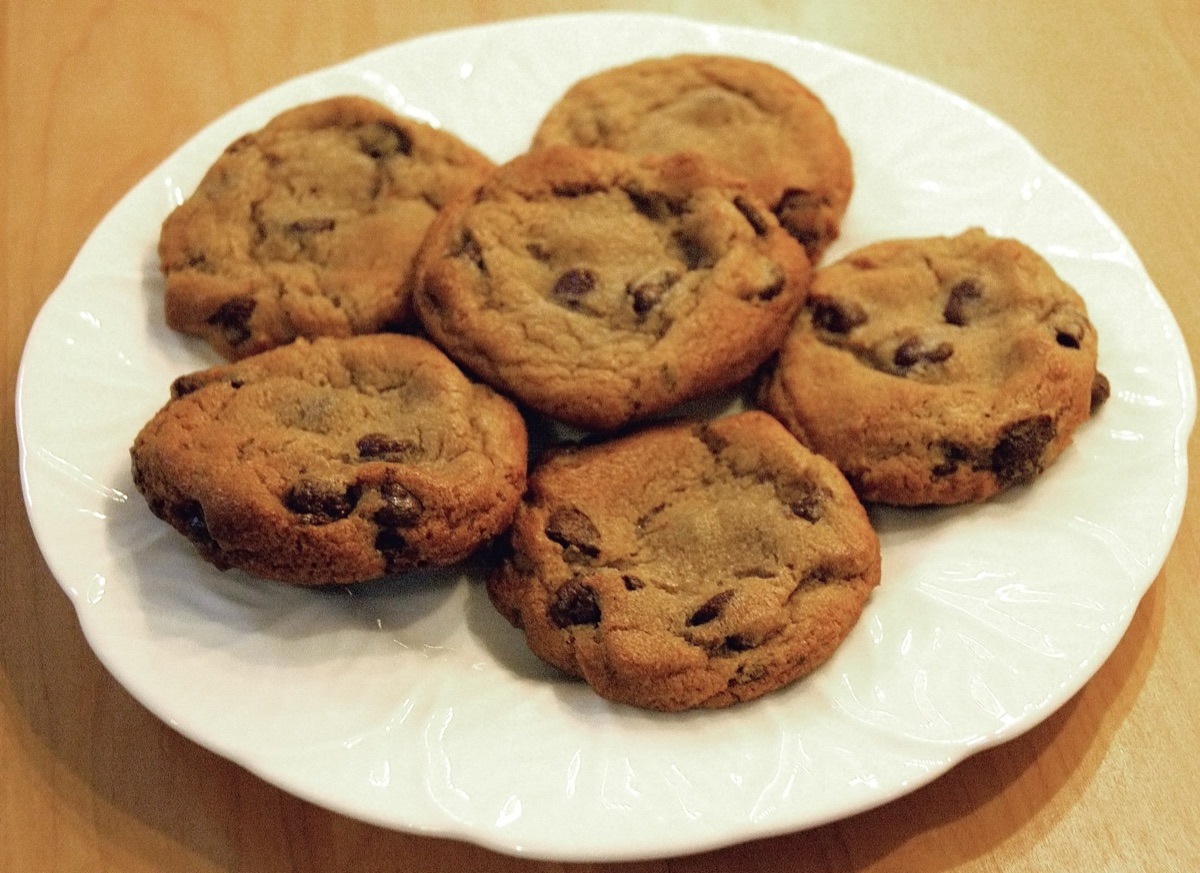
Homemade chocolate chip cookies. Image by Rdsmith4, CC BY-SA 2.5, via Wikimedia Commons.

Cooperative-extension guidance suggests your total production cost, the ingredients, labor, packaging, and labels combined, should run about 40 percent of the retail price. That implies pricing a cookie at roughly two and a half times what it costs you to make (Michigan State University Extension). For a baker who keeps lowballing, that is a concrete floor to push back against.
Home-bakery coach Aurelia Lambrechts names the feeling behind most underpricing:
“Home Baking is SUPER labour intensive, yet we feel too awkward & guilty to charge what our bakes are TRULY WORTH.”
Aurelia Lambrechts, home-bakery coach and founder of Philosophy of Yum, in Philosophy of Yum.
Ingredient prices also move every year. For 2026 the USDA projects sugar and sweets up about 6.9 percent while egg prices fall around 30 percent, so a cookie cost you worked out last year is worth recomputing before you reprice (USDA Economic Research Service).
The same cost can lead to a different price depending on whether you mark up from cost or work back from a target margin. These cooperative-extension examples show both methods side by side (Penn State Extension, Virginia Cooperative Extension).
| Source | Cost basis | Method | Markup or margin | Resulting price |
|---|---|---|---|---|
| Penn State Extension | $1.75 cost | Cost-plus | 60% markup | $2.80 |
| Penn State Extension | $1.00 cost | Cost-plus | 100% markup | $2.00 |
| Virginia Coop Extension | $2.25 cost of goods | Gross margin | 40% margin | $3.75 |
Allyson Grant, a culinary-trained baker who has run four bakeries, ties pricing back to your own numbers:
“Copying other bakers, instead of knowing your cost of goods, is the recipe for burn-out.”
Allyson Grant, artisan baker and founder of the Better Baker Club, in Better Baker Club.
A few traps come up again and again in baker forums:
- People often price on ingredient cost alone, the classic triple-the-ingredients-and-stop, and forget labor, packaging, electricity, and equipment wear.
- A common worry, then skipped anyway, is paying yourself for baking time, especially decorating hours, which quietly drops your rate to minimum wage or below.
- People often grab a one-size-fits-all rule like a dollar per inch, or a price from another region, then find it does not fit their own costs.
- Bakers frequently forget the hidden lines: bags and labels, failed or test batches, and steady ingredient price creep, so the profit they think they have is thinner than it looks.
What this tool does that others don’t
- It costs each ingredient from the package you actually buy, then splits the cost of a single cookie into four parts that add back up to the total: ingredients, labor, overhead, and packaging. You can see at a glance whether labor or ingredients is driving the price, shown as both numbers and a stacked bar.
- It keeps markup and profit margin separate. You set a markup over cost, and the tool reports the gross margin that markup implies, so a 50% markup is never mislabeled as a 50% margin the way it is on some pricing tools.
- It prices both per cookie and per dozen side by side, since bakers get asked for a per-dozen number constantly and the two figures should always agree.
- It separates per-cookie packaging from per-batch overhead. Packaging scales with each cookie while oven time scales with the batch, so a bigger batch correctly keeps packaging per cookie flat while spreading overhead thinner, instead of lumping the two together.
Limits of this estimate
This calculator is honest about what it leaves out. Keep these limits in mind before you trust the number:
- It only spreads the per-batch costs you enter. It leaves out one-time setup costs like buying a mixer or oven, a cottage-food license, business insurance, or a website, so the real cost of getting ready to sell is higher than the per-cookie figure.
- It cannot tell you what your local market will pay. The suggested price is just your cost plus the markup you chose, not market research, so always check it against comparable cookies sold near you before you set a price.
- It assumes every cookie in the batch is sellable. It does not count ingredient waste, test or failed batches, broken cookies, or freebies and samples, so your true cost per sellable cookie is a bit higher than shown.
- It leaves out the costs of selling: market-stall or farmers-market fees, delivery, card-processing fees, and sales tax. These come out of the profit per cookie, so treat that profit as a before-selling-costs figure.
- The starting ingredient rows and every default price are illustrative examples, not your real costs, and prices drift as butter, flour, sugar, and packaging change. The tool does no live price lookups, so re-enter your current prices before trusting the result.
- Markup here is a percentage of your cost, not of the selling price. The tool then reports the implied gross margin, so the two figures differ on purpose: a 50% markup is a 33% margin. If a buyer or competitor quotes a margin, confirm which one they mean.
- Every figure is computed at full precision and only the displayed numbers are rounded to whole cents, each on its own. So the four per-cookie parts can add up to a cent more or less than the displayed cost per cookie, and twelve times the per-cookie price can sit a cent or two off the per-dozen price. The underlying values reconcile exactly.
- Each ingredient row uses only the ratio of amount used to package size, so both must be in the same unit. The tool does no conversion and cannot catch a mismatch, so entering grams against a package size in ounces silently miscosts that line.
- Labor and overhead are treated as fixed for one batch and spread only across that batch’s cookies, while packaging scales per cookie. The tool does not average a cost across several batches, so the result reflects a single batch at the yield you enter.
Frequently asked questions
How do you calculate the cost of a cookie?
Add up the cost of one batch: your ingredients, your labor, which is hours times your hourly rate, per-batch overhead like oven power and equipment wear, and packaging. Then divide that batch total by how many cookies the batch makes. This calculator builds the ingredient cost from the line items you enter, then splits the cost per cookie into ingredient, labor, overhead, and packaging parts so you can see which one is driving it.
How do I work out the cost of each ingredient?
Enter how much of the ingredient you use and the size of the package you buy in the same unit, then the package price. The tool figures the line cost as amount used divided by package size, times the package price. For example, 280 grams of flour from a 2,270 gram bag costing $3.50 works out to about $0.43. Because both amounts share one unit, no conversion is needed, so add a row for every ingredient and the tool totals them.
How much should I charge for homemade cookies?
Start from your cost per cookie and add a markup on top. This tool suggests a price as your cost times one plus the markup you choose, so at the example defaults a $1.49 cookie at a 50% markup suggests $2.23. The right number depends on your market, so compare that suggested price against what similar cookies actually sell for near you, then adjust the markup to fit. The suggested price is a starting point, not market research.
What is the difference between markup and profit margin?
Markup is profit as a percentage of your cost; margin is profit as a percentage of the selling price. They describe the same dollar of profit from two directions, so they land on different numbers: a 50% markup is a 33% margin, and a 100% markup is a 50% margin. This calculator takes a markup because it is the easier lever to set, then shows the profit margin that markup implies so the two terms never trip you up.
Should I charge per cookie or per dozen?
Either works, and the two should agree, because a per-dozen price is just twelve times the per-cookie price. Bakers are often asked for a per-dozen number, so this tool shows both at once. Pricing per cookie makes it easy to mix sizes and flavors in one order, while a round per-dozen price can be simpler for bulk buyers.
Should I pay myself for baking time?
If you are selling cookies, yes. Your time has a cost, and leaving it out makes the cookies look cheaper to produce than they really are. Enter your hands-on hours and an hourly rate you are comfortable with; many home bakers start near their local minimum wage or a little above. If you bake purely as a hobby, set the labor rate or hours to 0 to see the ingredients-and-overhead cost only.
Why do homemade cookies cost more than store-bought?
Factories buy ingredients in bulk, run automated lines, and spread packaging and overhead across millions of units, so their cost per cookie is tiny. A home baker pays retail ingredient prices, packs each cookie by hand, and, as this calculator often shows, carries labor as the single biggest line in the cost. That hands-on time and small-batch scale are what a higher homemade price pays for.
How does batch size change my cost per cookie?
Your ingredient, labor, and overhead costs are largely fixed for one batch, so baking more cookies from that batch spreads those costs over more units and lowers the cost of each cookie. Packaging is the exception, because it scales per cookie. The what-if table on the page varies the batch size so you can see how much a bigger batch trims your per-cookie cost.