Golf Cart Finance Calculator
Estimate the monthly payment, total interest, and total cost of financing a golf cart. Enter the cart price, down payment, trade-in, APR, term, and optional sales tax to see the full loan picture, including a clean 0% promotional-financing path.
Estimate, not a financing offer. This tool does the amortization math on the numbers you enter; it does not pull live rates or approve credit. Your actual APR, term, and payment are set by the lender and depend on your credit, the cart, and any promotion. It also excludes dealer and documentation fees, registration, insurance, and add-ons.
Your golf cart loan estimate
- Monthly payment
- $266.26
- Amount financed (principal)
- $10,500
- Total interest
- $2,280
- Total of payments
- $12,780
You pay $2,280 in interest over 48 months, about 21.7% of the $10,500 you finance.
Where your payments go
- Amount financed (principal) $10,500 82%
- Total interest $2,280 18%
How the APR changes your monthly payment
| APR | Monthly payment |
|---|---|
| 7.99% | $256.29 |
| 9.99% | $266.26 |
| 11.99% | $276.45 |
How to use this golf cart finance calculator
- Enter the golf cart price, the sticker price before tax.
- Subtract any down payment and trade-in value to set the amount you actually borrow.
- Add your local sales tax rate if it applies. The tool figures tax on the price after the trade-in and folds it into the amount financed.
- Enter the APR your lender quotes, or 0 for a 0% promotional offer, and choose the loan term in months.
- Read your monthly payment, amount financed, total interest, and total of payments, and see how the loan splits between principal and interest.
How it works
This calculator treats a golf cart loan like any fixed-rate, fully-amortizing installment loan, the same math behind an auto loan or a mortgage (Consumer Financial Protection Bureau). It works in two parts: first the amount you borrow, then the payment that clears it.
To find the amount financed, the tool subtracts your trade-in and your down payment from the cart price, then adds sales tax if you enter a rate. The tax applies to the price after the trade-in allowance, the common way states tax a vehicle. What is left is the principal, the amount financed.
To find the payment, it spreads that principal across every month of the term with the amortization formula M = P × r × (1 + r)^n / ((1 + r)^n - 1), where P is the amount financed, r is your APR divided by 12 for a monthly rate, and n is the term in months (California State Board of Equalization). The result is a level payment that stays the same every month. Multiply it by the number of months for the total of payments, then subtract the principal to reveal the total interest, the real price of borrowing.
APR is the biggest lever on the payment: a higher rate raises the monthly figure, a lower one cuts it. Take the loan the tool loads by default, a $12,000 cart with $1,500 down at 9.99% over 48 months. You finance $10,500, pay $266.26 a month, and give the lender $2,280 in interest, about 21.7% of the amount you finance, for a total of $12,780.
Enter 0% APR, the kind of promotional financing some cart makers run, and that formula would divide by zero, so the tool instead splits the principal evenly across the term and charges no interest (Amortization calculator, Wikipedia). You supply the APR yourself, so you can model different quotes by changing one number; the tool never pulls live lender rates.
Examples
Enter a $12,000 cart with $1,500 down at 9.99% over 48 months and no sales tax, and the tool finances $10,500, returns a $266.26 monthly payment, $2,280 in total interest, and a $12,780 total of payments. It subtracts the $1,500 down from the price, then amortizes the remaining $10,500 at 9.99% across 48 months.
Enter a $9,000 cart with $1,000 down at 0% promotional financing over 36 months, and the tool finances $8,000, returns a $222.22 monthly payment, and shows $0 total interest. A 0% rate simply splits the $8,000 evenly across the 36 months, so the total of payments stays at $8,000.
Enter a $15,000 cart with a $3,000 trade-in, $2,000 down, 6% sales tax, and 7.99% over 60 months, and the tool finances $10,720, returns a $217.31 monthly payment, $2,319 in total interest, and a $13,039 total of payments. The 6% tax applies to the $12,000 price after the trade-in, adding $720 on top of the $10,000 left once the trade-in and down payment come out.
What the data says
Golf carts have no single loan product, so the rate you are quoted depends entirely on the channel: a dealer’s specialty lender, a credit union, a personal loan, or a credit card. The advice you hear most on owner forums is blunt, that rates can be awful and a credit union is worth a call. The honest move is to run your actual quoted APR before you sign, which is exactly what the box above is for.
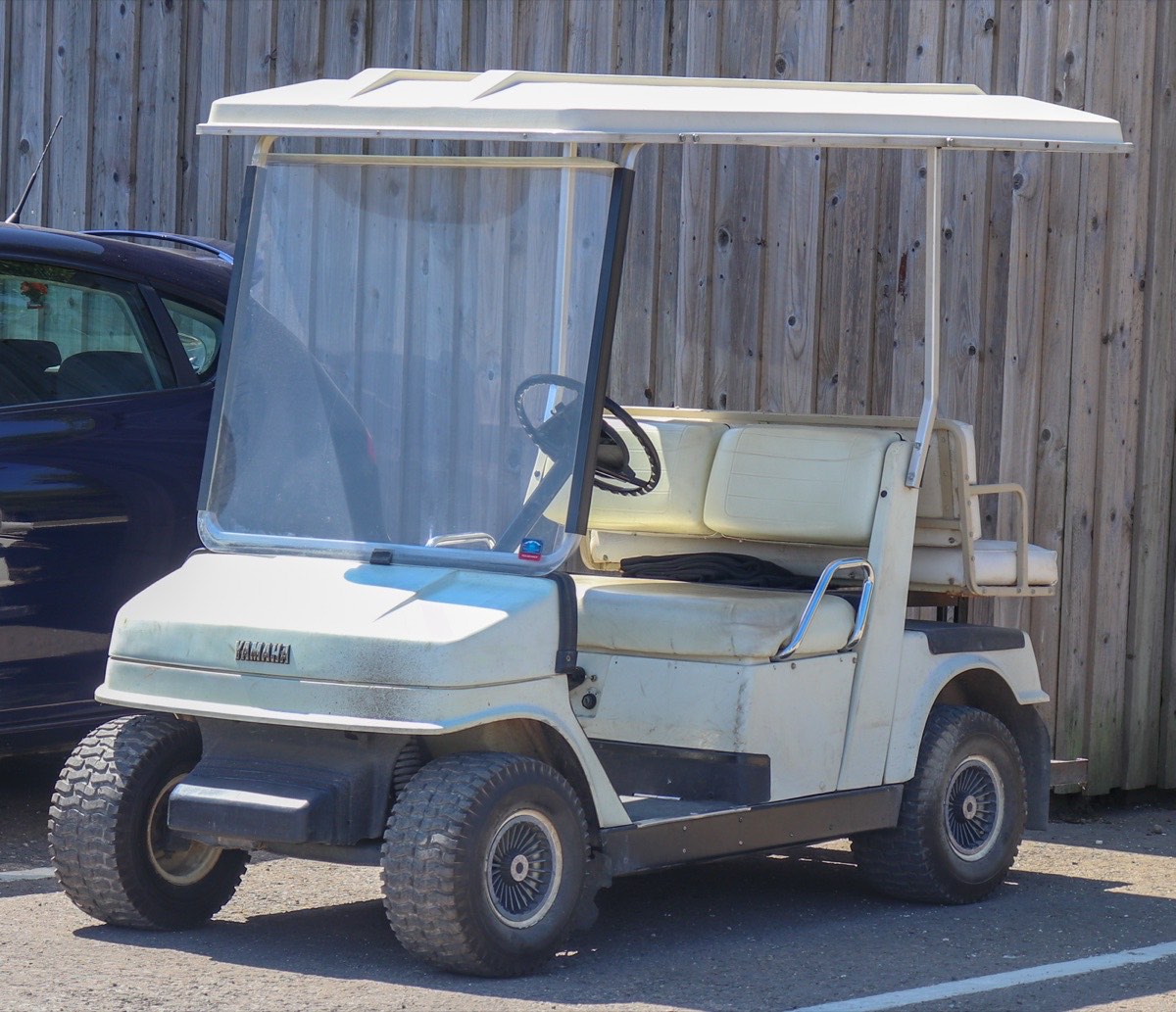
A Yamaha golf cart on display at the 2018 British Motor Museum Old Ford Rally. Image by Vauxford, CC BY-SA 4.0, via Wikimedia Commons.
.jpg)
Across all borrowers the average used-vehicle loan ran 11.87% APR in early 2025, but the rate stretched from about 5% for super-prime credit to nearly 22% for deep subprime, which is why the APR you type in moves the payment more than any other input (Experian).
This calculator breaks out the total interest and the total of payments for exactly the reason a Bankrate analyst warns about:
“People make the mistake of shopping based on what the monthly cost will be, rather than focusing on the total they will pay.”
Greg McBride, CFA, Chief Financial Analyst at Bankrate, in Consumer Reports.
A structured loan also costs far less than a card. A 24-month personal loan averaged 11.40% APR in early 2026 while credit cards that carried a balance charged about 21.5%, so putting a cart on a card can roughly double your cost of borrowing versus a fixed loan (Federal Reserve G.19). If you are not sure which APR is realistic for your credit, the table below pairs each tier with the average new and used auto-loan rate, so you can pick a row and plug it in (Experian).
| Credit tier (score) | New APR | Used APR |
|---|---|---|
| Super prime (781+) | 5.18% | 6.82% |
| Prime (661-780) | 6.70% | 9.06% |
| Near prime (601-660) | 9.83% | 13.74% |
| Subprime (501-600) | 13.22% | 18.99% |
| Deep subprime (300-500) | 15.81% | 21.58% |
| All buyers (average) | 6.73% | 11.87% |
Stretching a depreciating cart over 72 to 84 months carries a specific risk that an iSeeCars analyst describes bluntly:
“But while these loan periods work well for tight monthly budgets, they’re like financial quicksand for buyers, who will spend years owing more than the vehicle is worth.”
Karl Brauer, Executive Analyst, iSeeCars, in Forbes.
A few traps come up again and again, and they are worth heading off:
- A common mistake is taking the dealer’s first financing offer without a credit-union or bank pre-approval, then paying a marked-up APR.
- People often shop the monthly payment instead of the total cost, stretching to a 72 to 84 month term so the payment looks small while the interest piles up.
- People commonly forget to budget for sales tax, title and registration, dealer doc and origination fees, a street-legal LSV conversion, a lift kit, and the eventual battery replacement.
- A common worry is that the advertised 0% for 36 months promo will not be the rate they actually get at pickup, once the lender sets their credit tier.
What this tool does that others don’t
- It itemizes the full cost of the loan, not just the monthly payment. You see the amount financed, the total interest, and the total of payments, so you can judge the real lifetime cost of borrowing, which the dealer payment widgets that rank for this search leave out.
- It handles a 0% promotional offer cleanly. A standard amortization formula divides by zero at 0%, so a tool that does not special-case it returns no answer or a wrong one; here a 0% rate spreads the principal evenly and charges no interest.
- It lets you enter both a trade-in and a sales tax rate, and it taxes the price after the trade-in, the common US vehicle rule, so the principal it finances matches a real out-the-door purchase.
- It shows the amortization formula and explains how your down payment and trade-in cut the financed principal (Consumer Financial Protection Bureau), so the monthly payment is reproducible instead of a black box.
Limits of this estimate
This is a planning estimate, not a financing offer. Here is what it does not account for.
- It finances only the cart price plus optional tax. It leaves out dealer and documentation fees, origination charges, and add-ons like lift kits, upgraded batteries, or extended warranties that a lender may roll into the loan.
- It figures sales tax on the price after your trade-in, the common US rule. State rules vary: some tax the full price, some cap the trade-in credit, and some treat low-speed vehicles specially, so confirm your state’s rate. The tax here is an approximation.
- It does not include insurance, registration or titling, or the cost of a street-legal (LSV) conversion, all of which add to what you pay to own and run the cart.
- It cannot tell you whether you will qualify for the APR you enter. Your real rate depends on your credit, the lender (a dealer’s Sheffield Financial program, a bank, or a credit union), and any promotion, so the rate is an assumption you supply, not a quote this tool can promise.
- It assumes a fixed APR with equal payments for the full term. It does not model deferred-interest or promotional periods that later jump in rate, variable rates, balloon payments, or the savings from paying the loan off early.
- Interest compounds monthly: the periodic rate is the APR divided by 12. A lender that uses daily simple interest or a different day-count can disclose a payment a few cents off.
- The monthly payment is rounded to the cent and the total of payments is that rounded payment times the number of months, the figure lenders disclose. A real loan usually nudges the final payment by a few cents so the balance lands exactly on zero.
- Interest is charged from the first month, with no deferral or grace period. The 0% path assumes the rate stays zero for the whole term; it does not model a deferred-interest promotion that later jumps to a standard rate.
- The rate you enter is treated as the note rate that sets the payment, not an APR that folds in fees. With no fees the two match; once fees are financed, the disclosed APR is higher than the rate that produces this payment.
Frequently asked questions
How do you calculate a golf cart loan payment?
A golf cart loan payment uses the standard amortization formula, the same math behind an auto loan. You start with the amount financed, the cart price minus your trade-in and down payment, plus any sales tax. The formula applies your monthly rate, the APR divided by 12, across the number of months in the term and returns a level payment that stays the same each month. This calculator runs that math and also breaks out the amount financed, total interest, and total of payments.
What is the average interest rate on a golf cart loan?
There is no single golf cart rate, because the loan can come from a dealer’s specialty lender, a bank, a credit union, or a personal loan. For comparison, the average used-vehicle loan ran about 11.87% APR in early 2025, ranging from near 5% for the strongest credit to about 22% for the weakest (Experian). Enter the APR a lender actually quotes you rather than a guess, since the rate moves the payment more than any other input.
Can you finance a golf cart with no money down?
Often yes, if the lender allows it. Set the down payment to 0 and the tool finances the full price, plus any tax, minus your trade-in. A zero down payment raises both the monthly payment and the total interest, because you borrow more and pay interest on a larger balance. Whether you qualify with nothing down depends on the lender and your credit.
Do golf carts come with 0% financing?
Sometimes. Golf cart makers and dealers occasionally run 0% promotional financing for a set term. Enter 0 for the APR and the tool spreads the amount financed evenly across the months, so the total interest is zero. Read the offer closely, because some promotions defer interest and then charge it if the balance is not cleared in time.
Do you pay sales tax when financing a golf cart?
Usually, though it varies by state and sometimes by county. This calculator figures tax on the price after your trade-in, the common rule for a vehicle, and folds it into the amount financed. Some states tax the full price, and some treat low-speed vehicles (LSVs) differently, so enter your local rate or leave it at 0 if tax is collected separately.
Is it better to finance or pay cash for a golf cart?
It depends on the rate and your cash position. Paying cash avoids interest entirely, which is the real cost of borrowing the tool shows as total interest. A 0% promotional offer can make financing nearly free, while a high APR adds a lot over the term. Treat the total interest figure as the price of financing and weigh it against keeping your cash. This is an estimate, not financial advice.
How many years can you finance a golf cart?
Terms commonly run from a year up to about seven years, 6 to 84 months, and this calculator covers that range. A longer term lowers the monthly payment but raises the total interest you pay, and stretching a depreciating cart over 72 to 84 months can leave you owing more than it is worth. Compare a few terms to see the trade-off before you sign.
How accurate is this golf cart finance calculator?
The amortization math is exact for the numbers you enter, so the monthly payment, total interest, and total of payments are precise for that scenario. Real totals can differ because of dealer and documentation fees, taxes that vary by location, and the actual APR a lender approves. Treat the result as a solid estimate of the loan, not a financing offer.