Tire Life Calculator
Estimate how much tread life is left in your tires and roughly how many more miles and months you can drive before reaching the replacement limit, from a single tread-depth measurement.
Planning estimate, not a safety guarantee. This tool assumes tread wears at a constant rate and projects a single tire from one reading. It ignores tire age, uneven wear, alignment, load, and inflation, all of which change how fast tread disappears. 2/32 inch is the legal minimum; 4/32 inch is a wet-grip recommendation. Replace tires before the limit and check the DOT age separately.
Your tire life estimate
- Tread life remaining
- 50%
- Estimated miles to replacement
- 25000
- Estimated time to replacement (years)
- 2.1
- Wear rate (32nds per 10,000 mi)
- 1.6
- Starting tread depth (32nds in)
- 10.0
- Tread already worn (32nds in)
- 4.0
- Usable tread remaining (32nds in)
- 4.0
- Locked legal reserve (32nds in)
- 2.0
You have about 50% of your usable tread life left, roughly 25000 more miles and about 2.1 years (about 25 months) of driving before the tread reaches your 2/32 inch limit, about 1x the distance already on these tires.
Where your tread budget goes
- Tread already worn 4.0 40%
- Usable tread remaining 4.0 40%
- Locked legal reserve 2.0 20%
How your yearly mileage changes the time to replacement
| Miles per year | Years to replacement |
|---|---|
| 9000 | 2.8 |
| 12000 | 2.1 |
| 15000 | 1.7 |
How to use this tire life calculator
- Measure your current tread depth in 32nds of an inch with a tread-depth gauge or the penny test, and enter it.
- Enter the starting (new) tread depth of the tires. Most new passenger tires start near 10/32 inch.
- Pick the replacement limit: 2/32 inch is the U.S. legal minimum, or 4/32 inch for a wet-traction margin.
- Enter the total miles driven on the tires so the tool can measure how fast the tread is wearing.
- Enter how many miles you drive per year to turn the remaining miles into months and years.
- Read your tread life remaining, estimated miles to replacement, and the tread-budget breakdown of worn, usable, and locked reserve.
How it works
This calculator runs a linear tread-wear projection: it assumes your tread wears at a steady rate and carries that rate forward. First it finds your wear rate by taking the tread you have already lost, your starting depth minus your current depth, and dividing it by the miles you have driven. Then it measures the usable tread sitting above your replacement limit and divides that by the wear rate to estimate the miles you have left. Dividing those miles by how far you drive each year turns the answer into months and years.
In the U.S., 2/32 of an inch is the legal minimum tread depth, the level at which tires carry molded wear bars and traction drops off sharply (NHTSA TireWise). You can switch the limit to 4/32 inch, the depth at which wet braking and grip start to fade noticeably (Michelin). A new passenger tire usually starts near 10/32 inch, and its usable tread is the starting depth minus that worn-out reserve, so a 10/32 tire has about 8/32 inch to use (Tire Rack).
Here is a worked example. Say your tires started at 10/32 inch, read 6/32 inch now, and carry 25,000 miles, with the 2/32-inch limit selected. You have worn 4/32 inch over 25,000 miles, a wear rate of 1.6 per 10,000 miles. Half your usable tread is gone, so you have 50% of your tread life left, about 25,000 more miles, and at 12,000 miles a year, roughly 2.1 years before you reach the limit.
Two readings are needed to project miles. If you have not driven a measured distance yet, or your current depth still equals the starting depth, the tool shows your tread and percent remaining but holds the miles estimate until there is real wear to measure. If your current depth is already at or below the limit, it reports zero remaining life and tells you to replace now.
How far you drive each year is the biggest lever on the timeline: drive more and the years-to-replacement figure shrinks, drive less and it stretches. The wear assumption stays constant, so treat every number as a planning estimate, not a precise expiry date.
Examples
Half-worn tires, 25,000 miles in: enter 6/32 inch now, 10/32 inch when new, the 2/32-inch limit, 25,000 miles driven, and 12,000 miles a year. The tool returns 50% tread life left, about 25,000 more miles, and roughly 2.1 years, because you wore 4/32 inch over 25,000 miles, a rate of 1.6 per 10,000 miles, and 4/32 inch of usable tread sits above the limit.
Nearly worn, high-mileage driver: enter 3/32 inch now, 10/32 inch new, the 2/32-inch limit, 40,000 miles driven, and 15,000 miles a year. The tool returns 13% tread life left, about 5,714 more miles, and roughly 0.4 year, because only 1/32 inch sits above the limit and your wear rate is 1.8 per 10,000 miles. With this little tread left, it is time to shop.
Brand-new tires, no miles yet: enter 10/32 inch now, 10/32 inch new, the 2/32-inch limit, and 0 miles. The tool shows 8/32 inch usable and 100% tread life left, but holds the miles and years estimate, because there is no measured wear yet to set a wear rate. Come back after a few thousand miles and it can project the timeline.
Already at the legal limit: enter 2/32 inch now, 10/32 inch new, the 2/32-inch limit, and 50,000 miles. The tool reports 0 usable tread and 0% life left and tells you to replace now, rather than showing a misleading positive number, because your current depth has reached the limit you picked.
What the data says
Most people reach this page with one of two questions: how many miles before I replace these, or whether a shop quote is fair and they want a free second opinion. Tread depth is where both answers start, and the numbers below show why a worn tire is riskier than it looks, even when it still seems to have plenty of tread.
In AAA’s controlled wet-road testing at 60 mph, tires worn down to 4/32 inch needed about 87 more feet to stop than new tires, roughly 43 percent farther, and lost about a third of their cornering grip (AAA Newsroom). That is the gap between stopping in your lane and sliding into the car ahead. To picture what 87 more feet feels like from the driver’s seat:
“If tested side-by-side at 60 mph, vehicles with worn tires would still be traveling at an alarming 40 mph when reaching the same distance it takes for vehicles with new tires to make a complete stop.”
Megan McKernan, manager, Automobile Club of Southern California Automotive Research Center, in AAA Newsroom.
This is exactly why the calculator lets you switch the limit from the 2/32-inch legal floor to a 4/32-inch wet-traction target. Consumer Reports’ tire program manager puts it plainly:
“Begin shopping by 4/32nds, looking for deals, and replace the tires before the braking and wet-weather traction significantly degrade.”
Ryan Pszczolkowski, tire program manager, Consumer Reports, in When to Replace Your Tires.
The table below pairs each tread depth with its millimeter equivalent, the usable life this tool would show, the rough condition, and which coin test it matches, so you can sanity-check a gauge reading against a coin in your pocket (AAA Automotive).
| Tread (/32”) | Millimeters | Usable life left* | Condition | Coin test |
|---|---|---|---|---|
| 10 to 11 | 7.9 to 8.7 | 100% | New tire | n/a |
| 8 | 6.35 | 75% | Healthy | n/a |
| 6 | 4.76 | 50% | Good, keep monitoring | n/a |
| 5 | 3.97 | 38% | Replace soon, wet grip declining | Quarter: tread reaches Washington’s hairline |
| 4 | 3.18 | 25% | Wet-traction caution, replacement recommended | Quarter: top of Washington’s head shows |
| 3 | 2.38 | 13% | Worn | Between the coin marks |
| 2 | 1.59 | 0% (legal limit) | Replace now, illegal at or below | Penny: top of Lincoln’s head shows |
| 1 | 0.79 | Below limit | Unsafe | n/a |
*Usable life is measured from a 10/32-inch new tire down to the 2/32-inch legal limit, this tool’s own derivation, not the total rubber on the tire.
A wear bar makes that limit easy to spot without a gauge. Look into the grooves for the small raised blocks; when the tread wears down level with them, the tire is at 2/32 inch.
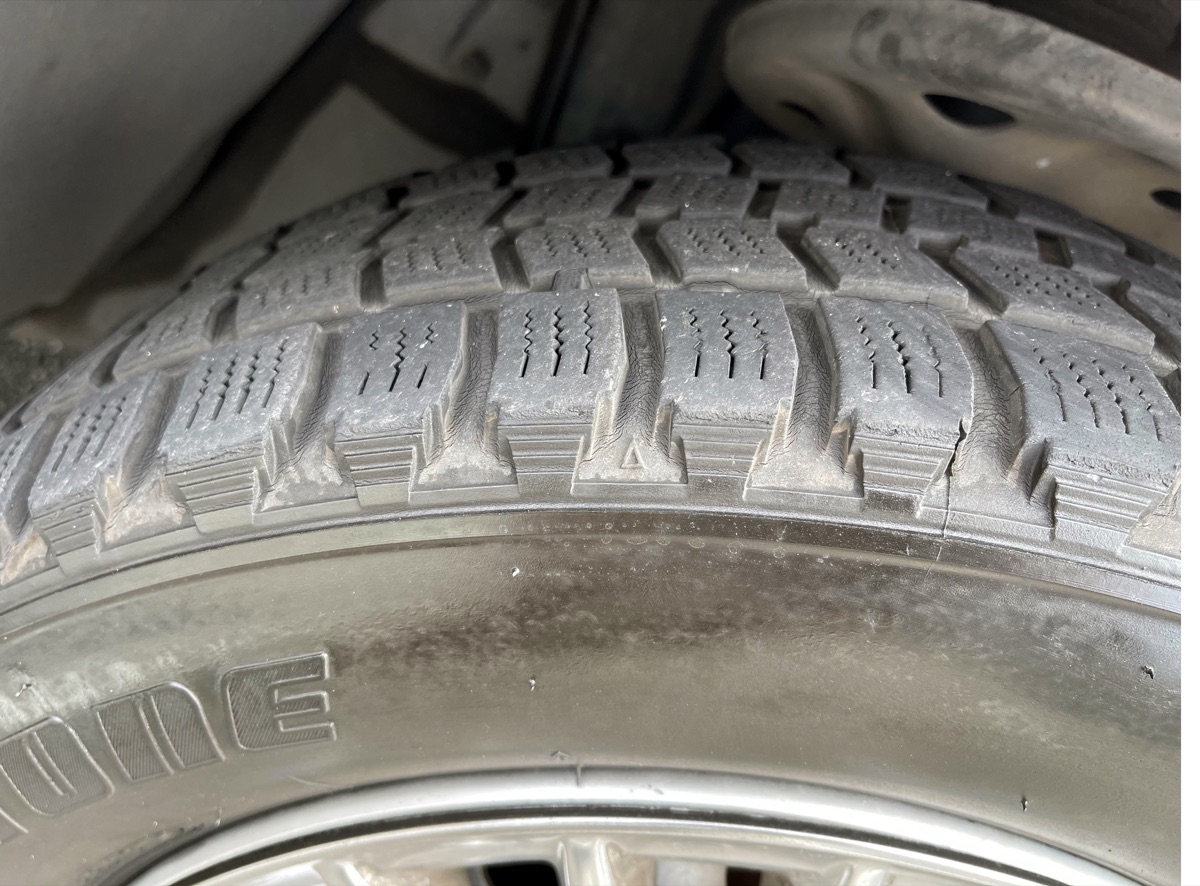
A tire’s molded wear bar and the small raised tread wear indicator block sit at the bottom of the grooves. When the surrounding tread wears down level with these blocks, the tire is at 2/32 inch and due for replacement. Image by VVVN, CC BY 3.0, via Wikimedia Commons.

The stakes add up across the country. Federal investigators tie tire problems to roughly 33,000 passenger-vehicle crashes and about 19,000 injuries a year, including 539 deaths in 2013 and 596 in 2014 (NTSB Safety Compass).
A few worries come up again and again, and they are worth heading off:
- A common one is “plenty of tread left, but the tires are old, are they still safe?” People judge safety by tread alone and forget that rubber ages, cracking and dry-rotting on a 6 to 10 year clock from the DOT date, even when the tread still measures fine.
- A common mistake is treating the mileage warranty as a wear prediction. Drivers expect a tire rated for 60,000 miles to last 60,000 miles, then wonder why it is worn out at 30,000. Measured tread is the honest check, not the warranty number.
- People often run one penny test on a single groove and assume the whole tire is fine, then get blindsided by uneven wear between the inner and outer edges, or between the front and rear tires.
- A common worry is whether 2/32 inch is a safe place to keep driving because it is legal. It is the absolute replace-now floor, not a target, so the “can I get one more winter out of these?” question usually deserves a no.
What this tool does that others don’t
- It projects the usable tread and the miles you have left from your own measured tread depth. The warranty calculators that fill this search only prorate a replacement price against a mileage warranty; none turn a tread reading into miles-to-replacement.
- It itemizes your tread budget into three parts: the tread you have already worn, the tread still usable above your limit, and the locked legal reserve below it that you can never use (Tire Rack).
- It lets you switch the limit between the 2/32-inch legal minimum and the 4/32-inch wet-traction recommendation, so you can see how much sooner the same tire reaches the stricter line (NHTSA TireWise).
- It shows the wear rate behind the estimate, in 32nds per 10,000 miles, so you can check the math. The result traces to your two readings and your mileage, not to undisclosed driving-style or climate multipliers you cannot reproduce.
- It anchors the replacement point to the NHTSA 2/32-inch minimum and the penny test, and keeps tire age separate, telling you to check the DOT date code rather than folding age into the tread projection (NHTSA TireWise).
Limits of this estimate
This is a planning estimate, not a safety verdict. Here is what it does not account for.
- It assumes tread wears at a constant rate. Real tires often wear faster when new and again when low, and the rate shifts with the season, so treat the miles and months as a rough projection.
- It uses one tread reading and projects a single tire. It cannot capture uneven wear across the tread face or the difference between your front and rear tires, which often wear at different rates.
- A miles projection only works once your current depth is below the starting depth and you have entered the miles driven. Before there is measured wear, or once a tire is at the limit, it shows tread status instead of guessing a miles number.
- It ignores tire age and rubber aging. A tire 6 to 10 years past its DOT date can need replacing for safety even with plenty of tread left, so check the date code separately.
- It does not model driving style, load, towing, road surface, alignment, rotation, or inflation pressure, all of which change how fast the tread disappears.
- It cannot tell you the single safe moment to replace. 2/32 inch is the legal floor, but many recommend 4/32 inch for wet grip, so use the estimate to plan rather than to push a tire to its limit.
- The math treats the whole limit you pick as a locked reserve, so switching to 4/32 inch shrinks the usable budget and the projected miles for the very same tire. 4/32 inch is a wet-grip recommendation, not a passenger-car legal requirement; federal rules set 4/32 inch only for the steer tires of large trucks and buses.
- The wear rate is shown to one decimal place in 32nds per 10,000 miles, so 1.75 displays as 1.8 and a hand check at full precision can differ by up to 0.05. The miles and years come from the full-precision rate, not the rounded display.
- Outputs are rounded for display: tread depths, the wear rate, and the years figure to one decimal, and the percent and miles to whole numbers, rounded half-up, so 12.5 percent shows as 13. The years estimate uses the unrounded miles, so dividing the displayed whole-mile figure by your annual mileage by hand can land a tenth of a year off.
Frequently asked questions
How does this calculator estimate tire life?
It measures how much tread you have worn so far, divides that by the miles driven to get a wear rate, then projects that rate forward until your tread reaches the replacement limit. It assumes wear is roughly constant, so the result is a planning estimate, not a guarantee.
What tread depth means I have to replace a tire?
In the U.S., 2/32 of an inch is the legal minimum tread depth (NHTSA), and that is also when the penny test fails: insert a penny with Lincoln’s head down and if you can see the top of his head, the tire is at or below 2/32 inch. Many experts recommend replacing at 4/32 inch for better wet-weather grip, which you can select as the limit.
Why won’t it show a miles estimate?
A miles-to-replacement projection needs real wear to measure. If you have driven zero miles on the tires or your current depth still matches the starting depth, there is no wear rate to project, so the tool shows your tread and percent remaining and asks you to come back once the tires have worn measurably.
What happens if my tires are already worn out?
If your current tread depth is at or below the replacement limit you chose, the calculator reports zero usable tread and zero remaining life and tells you to replace the tires now rather than showing a misleading positive number.
How do I measure my current tread depth?
Use a tread-depth gauge for the most accurate reading in 32nds of an inch, or use the penny test as a quick check. Measure across several points on the tire and use the lowest reading, since tires often wear unevenly.
Why is my estimate different from my tire’s mileage warranty?
A mileage warranty is a manufacturer promise based on average conditions, while this tool projects your actual measured wear rate. Aggressive driving, under-inflation, poor alignment, heavy loads, and rough roads all wear tread faster than the warranty assumes.
Does this account for tire age?
No. This is a tread-wear projection only. Rubber degrades with age regardless of tread, and many manufacturers recommend replacing tires 6 to 10 years after their DOT manufacture date even if plenty of tread remains. Check the date code separately.
Why does real tread wear faster than a straight line?
Tires often wear a little faster when brand new and again as they get low, and rate changes with season, alignment, rotation habits, and inflation. A linear model is a reasonable average but cannot capture those swings, so re-measure every few thousand miles and recalculate.